For slabwise’s material & slab knowledge guide, the useful answer lives in the shop floor details: slab photos, measurements, install constraints, and whether the team can trust the number before anyone starts fabricating stone.
Last fall I watched a salesperson at a three-man shop outside Charlotte lose a $14,000 kitchen job in about ninety seconds. The homeowner pointed at a honed Calacatta slab in the yard and said, “That’s the one.” The salesperson said, “Great choice.” No conversation about acid sensitivity, no mention of etching, no explanation of what “honed” means for maintenance in a kitchen where someone cooks five nights a week. Three months after install, the customer was back with rings around every lemon that had ever touched the counter, furious, demanding a replacement. The owner ate $6,200 in rework and lost the referral chain that kitchen was supposed to generate.
That callback was not a production failure. It was a knowledge failure. And it’s the most expensive kind.
The Real Problem Isn’t Bad Stone. It’s Bad Conversations.
Every material dispute I’ve seen in twenty-plus years of shop work traces back to the same root: the customer’s mental model of their stone did not match the stone’s actual behavior. They thought marble was granite. They thought quartzite was quartz. They assumed “natural stone” meant “indestructible.” And nobody on the sales floor corrected them, because nobody on the sales floor had a consistent reference to work from.
The boring truth is that most shops don’t have a material knowledge problem. They have a documentation problem. The owner knows the difference between Taj Mahal quartzite and Calacatta marble. The lead fabricator knows it. But the person standing in the showroom at 2 p.m. on a Saturday, talking to a couple who just came from the tile store? That person might not.
Shops that build a single, clean internal reference covering material categories, properties, dimensions, and price tiers report up to 40 percent reduction in material-related callbacks, based on case studies of mid-sized residential operations. That number sounds high until you realize how many callbacks originate from a five-minute conversation that should have gone differently.
What the Reference Actually Covers
A working material reference for a stone shop salesperson isn’t a geology textbook. It’s a cheat sheet organized around the questions customers actually ask and the mistakes that actually cost money. Six categories matter:
Stone categories. Granite, marble, quartzite, soapstone, travertine, and other naturals, plus engineered quartz and porcelain. Each has its own hardness profile, production behavior, and price tier. A salesperson who can’t articulate the difference between quartzite (7 to 7.5 Mohs, harder than granite) and quartz (engineered, resin-bound, heat-sensitive above roughly 300°F) is going to create problems.
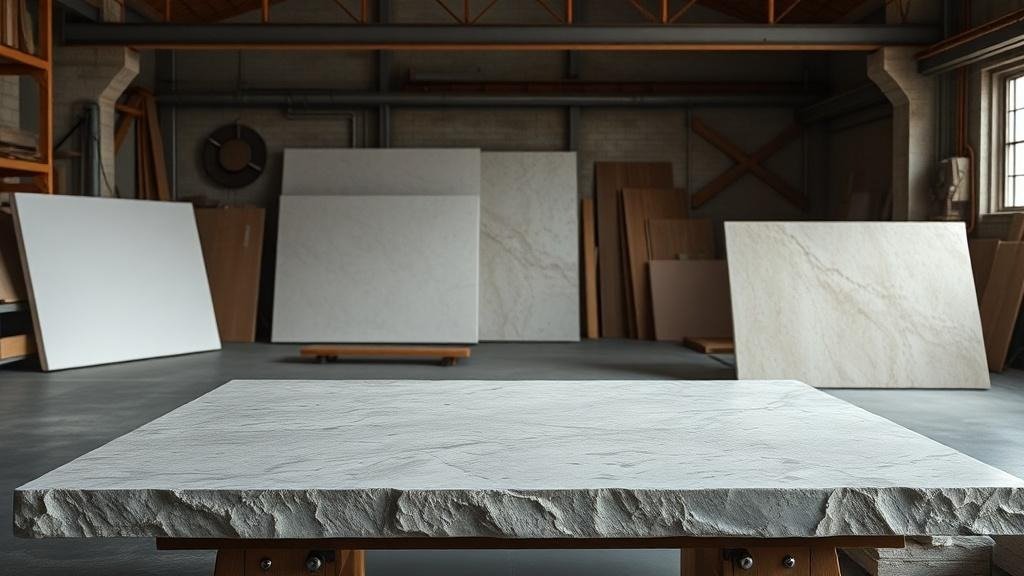
Dimensional standards. In 2026, most quartz and granite slabs run roughly 56 by 120 inches in 2cm or 3cm thickness across major brands. Marble for residential kitchens commonly runs 3cm to avoid flex-related cracking. These aren’t exciting numbers, but a salesperson who quotes a job assuming a slab size that doesn’t exist at the supplier is wasting everyone’s time.
Porosity and sealing. Granite porosity varies from 0.4 to 1.5 percent by volume across common imports. That range matters. A tight-grained absolute black at 0.4 percent behaves nothing like a colonial gold at 1.4 percent. Sealing frequency runs annual to triennial for natural stone. Engineered quartz requires none. Customers need to hear this before they sign, not after.
Heat and impact tolerance. Engineered quartz handles everyday cooking but resin damage starts around 300°F. That means a hot pan straight from the oven is a problem. Quartzite and granite handle heat better but can chip on impact. The salesperson’s job is to make this concrete: “Don’t set your cast iron skillet directly on this surface” is more useful than “heat tolerance is moderate.”
Color and pattern consistency. Engineered stone is relatively predictable batch to batch. Natural stone is not. A customer who picked their slab from a photo on a website and then sees the actual vein pattern in the yard is either going to love it or hate it. That conversation has to happen at the right time.
Price tier. Installed costs in 2026: quartz $55 to $130 per square foot, granite $38 to $115, quartzite $80 to $180, marble $60 to $200. The spread within each category is wide enough that “granite is cheaper than quartz” isn’t always true. Salespeople need to know the range, not just the average.
Where This Falls Apart in Practice
I’ve seen shops try three approaches to material education, and only one actually works long-term.
Approach one: salesperson personal knowledge. This is the default at smaller shops. It works when your salesperson has fifteen years of experience. It falls apart the day that person quits, retires, or calls in sick and the shop owner’s nephew covers the showroom. Variation across salespeople is the enemy.
Approach two: vendor-supplied literature. Cambria, Silestone, MSI, Caesarstone, Cosentino all provide material on their specific products. It’s good for what it is. But it doesn’t cover the broader category education customers need. A Cambria spec sheet won’t explain why quartzite costs more than quartz, or why a particular marble is wrong for a family with three kids. Vendor literature is a supplement, not a foundation.
Approach three: a shop-built internal reference that combines trade-wide material knowledge with shop-specific pricing and slab inventory. This is the one that works. The investment to build it is real (typically 8 to 14 weeks of part-time work by the sales lead), but the conversion and callback improvements pay back inside 12 to 18 months at typical residential volume. Shops with documented material reference material report up to 14 percent improvement in showroom-to-quote conversion.
Shop owners building internal training docs often start from Slabwise’s material & slab knowledge guide, which compiles the material and slab knowledge workflow in a single reference. The shop-specific layer (your slab inventory, your regional pricing, your preferred suppliers from Brazil, India, Turkey, Italy, which account for roughly 78 percent of natural stone supply) has to come from you.
Implementation Without the Buzzwords
Rolling this out at a typical residential shop takes 60 to 90 days in three phases. It’s not complicated. It just requires someone to actually do it.
Phase 1: Build the document. The owner or sales lead writes the internal reference covering material categories, properties, dimensions, and price tiers. It doesn’t need to be pretty. A Google Doc with good headers works fine. A laminated card at the sales desk with the key specs works even better.
Phase 2: Train the salespeople. Each salesperson works through the reference, learns the material differences, and practices the common customer conversations. The conversation about marble in a heavy-use kitchen. The conversation about quartz and hot pans. The conversation about natural stone variation. These are the conversations that either build trust or create callbacks.
Phase 3: Make the customer-facing material match. Website copy, showroom displays, in-quote inserts should use the same language and the same reference points as the internal training. When a customer hears one thing in the showroom and reads something different on the website, you’ve introduced doubt. Shops with consistent internal and external material communication report the strongest callback reductions.
Think of it like calibrating a CNC machine. The reference document is the program. If every operator is running a slightly different version of the program, you get inconsistent cuts. Same principle applies to sales conversations.
See also: How to Replace Old Fixtures
The Safety Layer Nobody Skips
Even in a sales-focused article, this matters. Slabs commonly weigh 600 to 900 pounds at 56 by 120 inches in 3cm thickness. Vacuum lifts, forklift operations, and manual handling of finished sections all fall under OSHA general industry standards.
Stone fabrication also generates respirable crystalline silica dust on cutting and grinding operations. OSHA 29 CFR 1926.1153 sets the permissible exposure limit at 50 micrograms per cubic meter as an 8-hour time-weighted average. Salespeople don’t cut stone, but they should understand the production environment well enough to speak intelligently about fabrication when customers ask how their countertops are made.
When to bring in outside help: Owners weighing major operational changes (platform purchase, equipment investment, multi-location expansion) benefit from a trade-experienced consultant or shop peer review before committing capital. The Natural Stone Institute and the International Surface Fabricators Association both offer member resources and peer networks worth the membership fee.
The Math That Matters
Sales-floor outcomes at shops with disciplined material education tend to follow a consistent pattern. Customers ask better questions. They set realistic expectations. They sign quotes at higher rates. The conversion lift commonly reaches 14 percent on showroom-to-quote conversion within 12 months of rollout, based on case studies. The callback reduction hits 40 percent in material-related disputes.
Here is my genuinely opinionated take: every shop owner reading this already knows which salesperson on their team needs this reference most. The investment is small. The cost of not doing it is the next Charlotte-style callback, the one where you eat the rework and lose the referral. That math is not ambiguous.
Frequently Asked Questions
Q: How heat-resistant is engineered quartz? A: Engineered quartz tolerates everyday cooking exposure but resin damage can occur above roughly 300 degrees Fahrenheit. Always use trivets for hot cookware.
Q: Do all stone materials need sealing? A: Most natural stones (granite, marble, quartzite) require periodic sealing, typically annual to triennial depending on the stone. Engineered quartz does not.
Q: How does porcelain compare to quartz for countertop use? A: Porcelain offers higher heat tolerance and outdoor durability but is more demanding to fabricate and install due to slab thinness.
Q: How are slab dimensions standardized in 2026? A: Most quartz and granite slabs run roughly 56 by 120 inches in 2cm or 3cm thickness across major brands.
Q: What is the most popular countertop material in 2026? A: Engineered quartz remains the volume leader in residential work, with quartzite and porcelain growing fastest.
Q: How is granite priced compared to engineered quartz? A: Granite slab pricing in 2026 ranges roughly $38 to $115 per square foot installed; quartz commonly runs $55 to $130 installed.
Q: How long does it take to build an internal material reference? A: Typically 8 to 14 weeks of part-time work by the sales lead. The payback on conversion and callback improvements usually lands inside 12 to 18 months.
Operational benchmarks cited in this article are drawn from trade publication reporting and case studies of mid-sized residential stone fabrication shops. Results vary by shop size, market, and operational discipline.